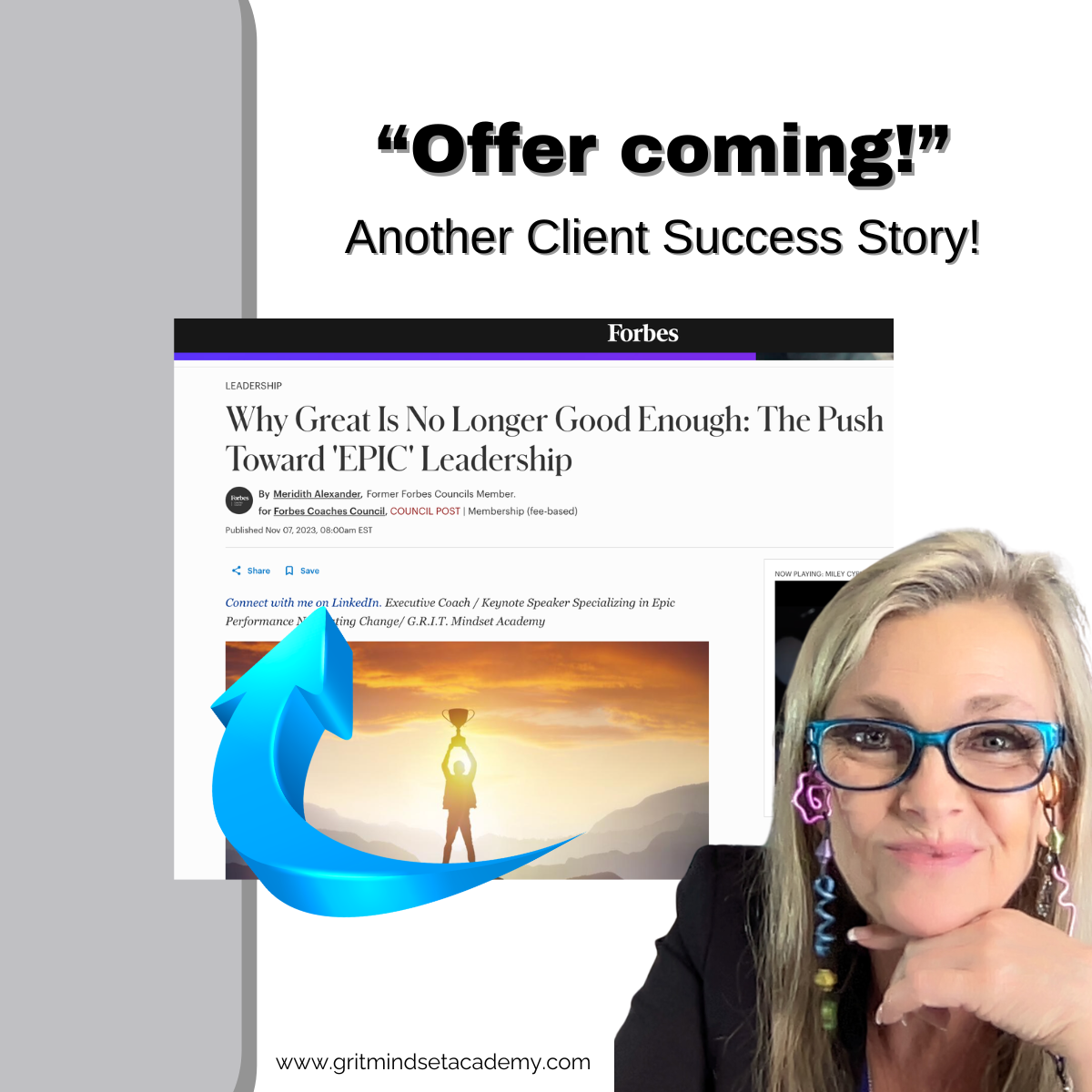
Yesterday, another client texted me with news of a verbal offer from a prestigious organization. It’s a total win/win—for them and for her.
Here’s what’s remarkable: Even in this current job environment where so much emphasis is being given to how tough it is to get hired, my clients are still getting job offers—and good ones.
So here’s what made me pause: I know what made these clients irresistible. But I’m willing to bet that most professionals — even those who hired them — can’t verbalize what made these people stand out.
My client who texted me yesterday is the perfect example.
Her resume is exceptional—the credentials, the technical expertise, the strategic experience. That’s what got her in the room.
But that’s not what made her irresistible.
What made her irresistible is something most organizations don’t know how to assess during hiring—and rarely prioritize when making promotion decisions.
I’ve observed that most promotions and job hirings follow predictable patterns: years of service, demonstrated interest in specific roles, technical proficiency, or the personal preferences of decision-makers.
Rarely are they rooted in the question that actually predicts success: Has this person developed the internal capacity to excel (or even lead) when there’s no roadmap?
Especially in high-complexity environments—including defense, intelligence, healthcare, tech, finance, government—success is no longer assured merely by all that you know. Success is often determined by who you show up being when “all that you know” is no longer enough.
Leadership and professional excellence in general demands far more than technical expertise, professional longevity or AI literacy. It requires something we rarely assess: the ability to navigate disagreement with composure, remain steadfast in purpose under pressure, and influence through trust rather than authority.
My client will thrive in this role not because of what she knows—though she knows plenty.
She’ll thrive because of who she’s become.
She’s developed the patience and curiosity to listen before directing. She will understand when to create space for others to contribute first because she understands that her idea may become even better when others share differing perspectives. This isn’t passive listening—it’s intentional. It creates psychological safety where people can share honestly.
She understands that, in today’s world, conflict is often no longer perceived as just a workplace disagreement. Optimal professional performance has become a source of personal identity which means that criticism — even when intended to be constructive — is often experienced as a challenge to identity, value, and dignity. So she’s learned to speak the language of diverse personalities and navigate those moments without losing her center.
She recognizes that leadership is evolving into the art of influence, not authority. She remains grounded in purpose while continually encouraging and developing those around her. She sees her own success in the context of whether she is also able to elevate others while she is pursuing industry excellence.
These aren’t competencies you typically cultivate in a standard professional growth workshop. They’re internal states you cultivate through deliberate practice.
But here’s the critical part: Even the most disciplined, well-versed, and dedicated individual cannot uncover these qualities on their own.
This is where it becomes essential to work with a coach who is trained not only in leadership principles but in the development of your inner game—someone who can help you see the blindspots and growth opportunities that remain invisible when you try to make these changes in isolation.
The transformation my client underwent wasn’t about learning new frameworks. It was about developing the internal sovereignty to remain Empowered, Purpose-driven, Innovative, and Collaborative even when everything around her is chaos.
That’s EPIC. And it’s what separates leaders who know what to do from leaders who can actually do it under relentless pressure.
I call this the leadership mind.
Here’s what I keep seeing: Organizations hire and promote based on credentials and tenure, then wonder why technically brilliant people struggle when the environment demands something different.
The real question isn’t “What do they know?” or “How long have they been here?” It’s “Have they developed the internal fortitude that makes external performance sustainable?”
Because organizational systems don’t transform sustainably unless the leaders implementing them have transformed internally first.
My client didn’t just prepare for interviews. She did the deeper work—the internal transformation that will allow her to sustain excellence when the pressure compounds and the variables multiply.
That organization is getting someone exceptional. And they probably don’t fully realize yet what makes her exceptional.
The truth is: the more clients that I work with (and I have worked with hundreds over the years), the more clear it is becoming that the previous generation’s definition of “great” leadership is no longer good enough.
We need professionals that are willing to challenge themselves to become EPIC.
I explored this evolution in my Forbes Coaches Council article back in 2023. The shift has only accelerated since then.
If you’re recruiting, developing, or leading teams in either heart centered industries or those with high-stakes complexity—if you’re trying to identify what actually predicts leadership success and professional excellence beyond the resume—this conversation matters.