We’ve all been there.
You’re having a perfectly good morning until someone makes a comment that sends you spiraling. Or maybe you’ve been toying with the idea of making a career move but then you read something that fills you with so many doubts that now you feel paralyzed. Or you’re sharing an idea in a high-stakes meeting when a team member says something that feels like a gut punch. Maybe you snap at someone you love, even though you swore you wouldn’t.
And in those moments, it feels like your emotions have hijacked the wheel.
So we do what any reasonable, high-achieving professional does: we try to control our circumstances. We avoid certain people. We micromanage situations. We build elaborate systems to protect ourselves from negative triggers.
We treat our emotions like unruly toddlers—unpredictable, inconvenient, and definitely capable of adding chaos to any situation.
But here’s what I’ve learned over two decades of studying the inner game of excellence, working with executives navigating high-pressure environments, and yes—surviving a boulder falling on my daughter in Colombia:
Your emotions aren’t the enemy.
In fact, they might be the most valuable leadership tool you’re ignoring.
What If Your Emotions Are Actually Your Guidance System?
Remember playing the “hot and cold” game as a kid? Someone hides an object, and as you search, they tell you whether you’re getting warmer (closer) or colder (farther away).
Your emotions work exactly the same way.
They’re not random noise. They’re not involuntary reactions you’re stuck with. They’re feedback—a sophisticated internal GPS pre-programmed to guide you toward what you actually want.
The emotions we label as “positive”—hope, enthusiasm, optimism, joy—signal that you’re thinking thoughts that move you closer to your goals. In this state, you have access to that best version of yourself. You’re more creative. More receptive and aware of opportunities and untapped potential. More magnetic to solutions, synchronicities and situations that feel perfectly aligned to your desired progress. Your communication flows. Your decisions sharpen.
The emotions we label as “negative”—frustration, anger, fear, doubt—signal that you’re thinking thoughts that move you away from what you want. You’re creeping into flight or flight mode. You’re less able to see possibilities. More reactive. More likely to sabotage your own progress. You’re using your imagination to create a never-ending string of fear, worry and self-doubt.
But here’s the critical insight most people miss:
It’s not your circumstances creating those emotions. It’s your thoughts about your circumstances.
And unlike your circumstances—which you can’t always control—you absolutely can develop sovereignty over your thoughts.
But it does require the training, practice and self-discipline similar to the dedication required to achieve a high level of physical health and fitness.
The Myth That’s Keeping You Stuck
Most leaders operate under a dangerous myth:
“Once my circumstances change, then I’ll feel better. Once I can get the difficult team member to change, once the project is finished, once I get the promotion—then I’ll feel calm, confident, and in control.”
But that’s backward.
Your external results are a reflection of your internal state—not the other way around.
I’ve worked with executives who had studied every external leadership strategy but who failed to tap into the full potential of their team because their own emotions kept their team members on edge. I’ve also worked with people facing seemingly impossible obstacles who generated extraordinary outcomes because they learned to master their internal operating system first.
This isn’t about positive thinking or forced gratitude. It’s about understanding how the system actually works.
When you’re in a negative emotional state, you’re literally operating from a different part of your brain. Your access to creative problem-solving narrows. Your ability to communicate effectively diminishes. You filter opportunities through a lens of scarcity and threat.
When you’re in a positive emotional state, your nervous system relaxes. Your prefrontal cortex comes back online. You see solutions you couldn’t see five minutes earlier. You respond instead of react.
Same circumstances. Different operator. Different results.
The Emotional Guidance Scale: Your Leadership Ladder
Over the weekend, my daughter Schuyler (Ms. Wheelchair Florida 2025) and I attended an Abraham Hicks live event in Orlando with Esther Hicks.
I discovered the work of Abraham Hicks more than 20 years ago when the book Ask and It Is Given literally fell off a bookshelf at Barnes & Noble and landed at my feet. (Yes, really.)
Their work synthesized everything I’d been studying since I was 16—from Plato and Socrates to Eastern philosophy, aikido, NLP, and energy healing. It’s why I was able to respond so quickly when the boulder fell on Schuyler.
And one of their most powerful tools is the Emotional Guidance Scale.
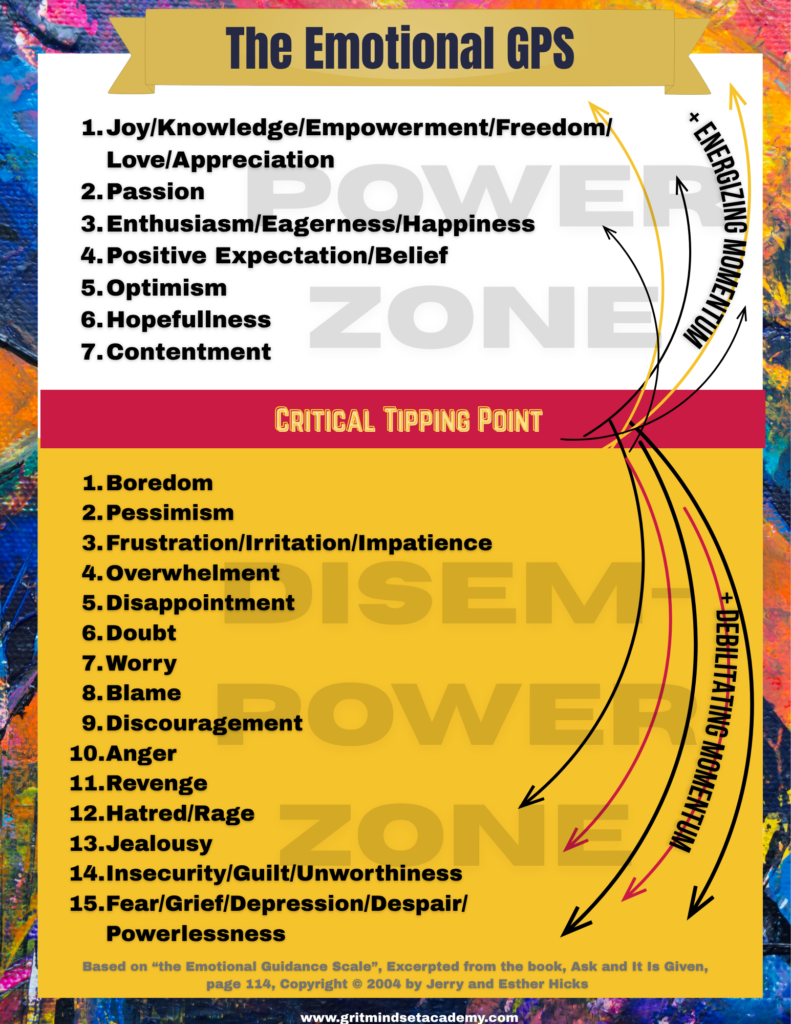
This Emotional Guidance Scale and my ELF strategy (Envision, Language, Focus) work hand in hand at the core of the Sovereign Impact Method™. The Scale shows you where you are emotionally. ELF gives you the muscles to climb it—to find the open window in a room that appears to have only locked doors.
Think of the Emotional Guidance Scale as a ladder with 22 rungs. At the top: joy, love, freedom, empowerment. At the bottom: fear, grief, powerlessness, despair. And everything in between.
Here’s why this matters for leaders:
The objective is not to leap from despair to joy in one move.
You just have to find one thought that feels slightly better. Then another. Then another.
That’s where my ELF strategy comes in.
Let’s say you’re furious with a team member who dropped the ball on a critical deadline. You’re at “anger” on the scale.
The goal isn’t to force yourself to feel “appreciation” for them. That’s too big a jump, and your nervous system won’t buy it.
And here’s what’s also crucial: You do not take action while you’re still in anger. That’s a recipe for damaged relationships and regrettable conversations.
Instead, you use anger as an internal recalibration point—in the language of a GPS, this is “your current location”. Your destination? A state where you are feeling confident that success is possible, that you can unearth an approach that helps the team member “course correct” in a way that potentially improves their productivity not just on this project but on all future projects.
Your current state of anger helps you in the immediate moment to reclaim your power. It pushes you away from feeling powerless. But before you take any external action, you realize that your best ideas and performance will come when you cross that emotional tipping point and start getting out of that mental state where you are stuck in fight or flight mode.
Your ultimate success depends on your ability to keep climbing the ladder. Enter the ELF Strategy from my Sovereign Impact Method™: Envision, Language, and Focus.
These three muscles help you find thoughts that genuinely feel better—not through forced positivity, but through deliberate internal recalibration.
The Three Inner Game Muscles That Change Everything
When you’re stuck in a negative emotional state, you can’t just think your way out by willpower alone. You need a structured process.
That’s where the ELF Strategy comes in. These are the inner game muscles you strengthen to develop what I call Internal Sovereignty—the ability to govern your internal state under pressure so circumstances don’t dictate your performance.
Let’s break down how to use each one to climb the emotional ladder:
Muscle #1: ENVISION
Use your imagination to envision a plot twist that feels slightly better.
When you’re angry, your imagination automatically runs worst-case scenarios. You picture the confrontation going badly. You rehearse all the ways the other person might disappoint you again. You imagine them being defensive, dismissive, or making excuses.
That imagination loop (when untrained and lacking intentional guidance) keeps you stuck in anger—or worse, pushes you down into frustration or powerlessness.
But here’s the shift: Your imagination is a muscle you can direct.
Instead of letting it run on autopilot, deliberately guide it toward a thought that feels even slightly better.
Example:
You’re furious with your assistant for overwhelming you with a barrage of non-urgent emails throughout the day, derailing your focus on critical priorities.
Your automatic mental movie: “She’s never going to get this. I’m going to have to keep dealing with this forever. If I try to correct her yet again, the conversation is going to be awkward and she’s going to get defensive.”
Envision a plot twist:
“What if I could have this conversation in a way that actually makes her feel valued while also helping her understand what I need? What if she’s overwhelmed too and just needs clearer guidance? What if, six months from now, she’s become so good at prioritizing that I actually can’t imagine working without her? The truth is that there are many times that it has taken me time to change a habit or pattern so it’s not surprising that it’s taking her time as well. I can be persistent without making her defensive so I’m confident that as time progresses, she WILL eventually master this.”
Notice—you’re not pretending the problem doesn’t exist. You’re envisioning a version of the outcome that feels better. And that slight shift in your internal movie moves you up the ladder from anger toward something closer to hope or determination.
Muscle #2: LANGUAGE
Substitute words that create thoughts that feel energizing or more hopeful versus overwhelming.
The words you use internally shape the emotions you experience. And most of us unconsciously use language that amplifies stress, scarcity, and struggle.
Small shifts in language can create significant shifts in emotional state.
Example:
Instead of: “My biggest challenge is to figure out a system with my assistant so she stops overwhelming me with emails.”
Try: “My biggest commitment is to figure out a system with my assistant so that she learns how to prioritize her communications with me better while still feeling appreciated. Something this important is worth any time needed to get things working well so that we both feel the win/win in the relationship.“
Do you feel the difference?
“Challenge” evokes struggle, resistance, and burden.
“Commitment” evokes intention, agency, and purpose.
Same situation. Different emotional frequency.
You can also use language to ask better questions—questions that your brain can actually answer in a way that moves you forward.
Instead of: “Why does she always do this?” (which keeps you stuck in frustration)
Ask: “Has anyone ever had an assistant who overwhelmed them with countless emails during the day who actually managed to train their assistant into such a valuable asset that they now feel like their assistant is a critical piece in their own success?”
The answer is undoubtedly yes.
And if others can do it, you can too.
That question shifts your brain from “this is impossible” to “this is solvable”—and you just moved up several rungs on the ladder.
Muscle #3: FOCUS
Am I focusing on what I want, or on the lack of what I want?
This is the game-changer.
Most of us spend our mental energy focused on describing the problem, cataloging the obstacles, and itemizing everything that’s missing or broken.
And the more we focus there, the more stuck we feel.
But here’s the discipline: Shift your focus to the feeling you want your actions to help you achieve—rather than allowing your focus to get stuck on the obstacles that are currently in your way.
Example:
Instead of focusing on: “My assistant sends me way too many emails. I can’t get anything done. She doesn’t understand priorities. This is so frustrating.”
Shift your focus to: “What I really want is to feel supported, efficient, and like my time is being respected. I want to feel like my assistant and I are a seamless team. I want to walk into my day knowing that the most important things are handled and I can focus on what only I can do. This will be an amazing scenario so it will be worth any effort that I invest in order to achieve it.”
Now ask yourself: “What’s one small step I could take toward that feeling? Can I be ok with allowing this to be worth more than just one conversation? Rather than expecting the entire problem to be solved now, can I break it down into several smaller adjustments over time so that we are both set up to see progress?”
Maybe it’s scheduling a 15-minute conversation to clarify priorities. Maybe it’s creating a simple system for flagging urgent versus non-urgent items. Maybe it’s acknowledging one thing she’s doing well before addressing what needs to change.
When you focus on the feeling you want and the outcome you’re moving toward, your brain starts generating solutions. Your nervous system relaxes. You access creativity, clarity, and confidence.
You’ve crossed the tipping point.
Putting It All Together: The Ladder in Action
Let’s walk through a real-world scenario using all three muscles.
Situation: Your assistant has been overwhelming you with emails all day. You’re furious. You’re at “anger” on the emotional ladder.
Step 1: Recognize the signal.
“I’m angry. That’s feedback. My thoughts right now are moving me away from what I want. Before I take action, I need to climb the ladder.”
Step 2: Use ENVISION to find a better-feeling thought.
“What if this conversation could actually be a turning point? What if, instead of being defensive, she’s relieved to have clearer direction? What if six months from now, I’m telling someone how grateful I am that I took the time to train her properly?”
You just moved from anger to frustration to relief or maybe even to hope.
Step 3: Use LANGUAGE to reframe.
“My biggest commitment is to create a system where we both feel supported. Has anyone else ever successfully trained an assistant who started off overwhelming them? Yes. Even if it takes a bit of time, this is solvable.”
You just moved from frustration to cautious optimism.
Step 4: Use FOCUS to lock in the climb.
“What I really want is to feel like we’re a team. I want to feel supported and efficient. What’s one small step I can take toward that feeling? I can schedule a brief conversation where I acknowledge what she’s doing well and introduce one new priority system. We don’t have to solve the entire problem in one (or even two) conversations.“
You just crossed the tipping point. You’re now in hope, maybe even positive expectation.
And now—only now—do you take external action.
You schedule the conversation. But you’re no longer operating from anger. You’re operating from clarity, intention, and alignment.
Your assistant feels it. The conversation goes differently. The outcome shifts.
Not because the circumstances changed. Because you changed first.
This Is Internal Sovereignty
In my work with leaders, I call this Internal Sovereignty: the disciplined governance of your imagination, your internal narrative, and your focus under pressure.
It’s not about controlling your circumstances. It’s about mastering the operating system underneath your actions.
Because here’s the truth:
You can have the best strategy, the most cutting-edge leadership techniques, the clearest vision—but if your internal state/mood is unstable, none of it holds.
On the other hand, when you develop sovereignty over your emotional state, everything changes:
- Clarity sharpens.
- Communication stabilizes.
- Decision-making accelerates.
- Energy returns.
- Momentum compounds.
- Teams respond differently.
- Opportunities expand.
This isn’t motivational language. It’s operational reality.
Your Emotions Are Pre-Programmed to Guide You
If you feel like your emotions are impacting how you experience your life—or the results you’re seeing personally and professionally—I want you to consider this:
Your emotions aren’t defective. They’re not sabotaging you.
They’re a sophisticated GPS system, pre-programmed to help you reach your target.
When you take a wrong turn, your GPS squawks. When you’re back on course, the arrow aligns.
Your job isn’t to silence the GPS. It’s to learn how to read it.
And the way you read it—the way you climb the ladder—is by strengthening your three inner game muscles using the ELF Strategy:
Envision a plot twist that feels better.
Language your way into thoughts that energize instead of deplete.
Focus on what you want and the feeling you’re moving toward.
One thought at a time. One rung at a time.
Until you cross the tipping point—and momentum starts working for you instead of against you.
Start Here
If you’re ready to stop being at the mercy of your emotions and start using them as a strategic advantage, here’s your practice:
1. Notice the signal.
When you feel a negative emotion, pause and acknowledge: “This is feedback that is trying to help me see a clue. What is this telling me about the thoughts I’m thinking right now? What is it telling me about the expectation that I have? Am I assuming something that is not necessarily true?”
2. Identify where you are on the ladder.
Are you in anger? Fear? Overwhelm? Frustration? Just name it. Awareness is half the work.
3. Use the ELF three Inner Game Muscles to find one thought that feels slightly better:
- ENVISION: What plot twist could I imagine that feels even a little better than what I’m currently picturing?
- LANGUAGE: What word could I substitute or what question could I ask that shifts my emotional state?
- FOCUS: Am I focused on what I want, or on what’s missing? What feeling am I actually trying to create?
4. Keep climbing.
Once you find that slightly better thought, find another. And another. You’re following the path of least resistance upward.
5. Notice when you cross the tipping point.
There’s a moment—usually around “contentment” or “hopefulness”—where the emotional momentum shifts. You’ll feel it. Often with a sigh or a breath signaling some sort of relief. That’s when the work gets easier.
6. Now—and only now—take external action.
From this higher vantage point, make the decision. Have the conversation. Lead your team. You’ll show up differently—and your results will reflect that.
This Is the Work
When you learn to use your emotions as a GPS and strengthen your Inner Game Muscles, you stop being reactive. You start being intentional.
You stop waiting for perfect circumstances. You start creating the outcomes you want—from the inside out.
And you finally access the version of yourself you’ve always known was possible.
That’s when you become unstoppable.
That’s when you step into the most EPIC version of yourself: Empowered. Purpose-Driven. Innovative. Collaborative.
And that’s when everything—your relationships, your leadership, your results—starts to shift.
Want to go deeper?
If you’re ready to develop Internal Sovereignty and learn how to use your emotions as a strategic advantage, let’s talk. This is exactly the work I do with executive leaders and high-performing professionals through the Sovereign Impact Method™.
Because the leader you’re becoming isn’t waiting on the other side of perfect circumstances.
That leader is waiting on the other side of internal mastery.
And you’re closer than you think.
Schedule a discovery conversation here
Meridith Alexander is an executive coach, Forbes contributor, and creator of the Sovereign Impact Method™. She specializes in helping leaders develop Internal Sovereignty so they can perform powerfully under pressure—even when circumstances are unpredictable. Learn more at gritmindsetacademy.com or meridithalexander.com.