Most people quit right before the magic happens—
Don’t be that person…!
If you’re reading this and you don’t feel like success is coming naturally to you, let me start here: you’re in good company.
Not everyone is born an overnight success. Most people don’t evolve into their best selves early in life or early in their careers. You don’t have to get it right the first time. You don’t have to arrive fully formed as the “perfect leader.”
Let’s destroy a myth: successful leaders aren’t born. They’re forged.
In fact, most of the individuals we admire most had at least one spectacular failure, one cataclysmic life event, or one period of soul-crushing self-doubt.
So what separated them from everyone else who faced similar challenges?
It Wasn’t Just Grit
Yes, grit matters. Resilience matters. But there’s something deeper that allows certain individuals to emerge from transformative events as versions of themselves that were previously unimaginable.
It’s the ability to play the inner game.
Where Strength Is Really Built
Our greatest strengths aren’t honed in seminars or built from motivational quotes. They’re forged in times of great challenge, pressure, and uncertainty.
They emerge in those moments when:
- All of your concepts and strategies fall flat
- The pressure exceeds anything you thought you could handle
- The only thing standing between you and collapse is your ability to find a reason to believe in yourself
These are the moments that matter. These are the crucibles that create transformation.
The Work I Do
This is what I teach. How to cultivate those seeds within yourself. How to develop the capacity to choose “I can” over “I can’t” when every logical reason points toward quitting.
It’s not about toxic positivity or pretending challenges don’t hurt. It’s about building the internal infrastructure that allows you to transform through pain rather than be destroyed by it.
And honestly? I love this work so much that it doesn’t feel like work at all. As Peter Pan would say, when you love what you do and do what you love, you don’t work a day in your life.
Give Yourself Permission
My challenge to you: give yourself permission to be messy. To struggle. To have moments when the sky goes dark.
Be willing to maintain faith in yourself, in life, and in the potential of others—especially when things get complicated and uncertain.
Remember that the best fairy tales never end with the poison apple moment. That moment simply reveals where the real magic has been hiding all along.
And the real magic? It’s always, always, always the way the hero (or shero) discovers how to play their own inner game to win.
Your transformation isn’t waiting for perfect conditions. It’s waiting for you to decide that even in the darkness, you’ll find a reason to believe.
Curious about those dynamo’s challenges? Read on!
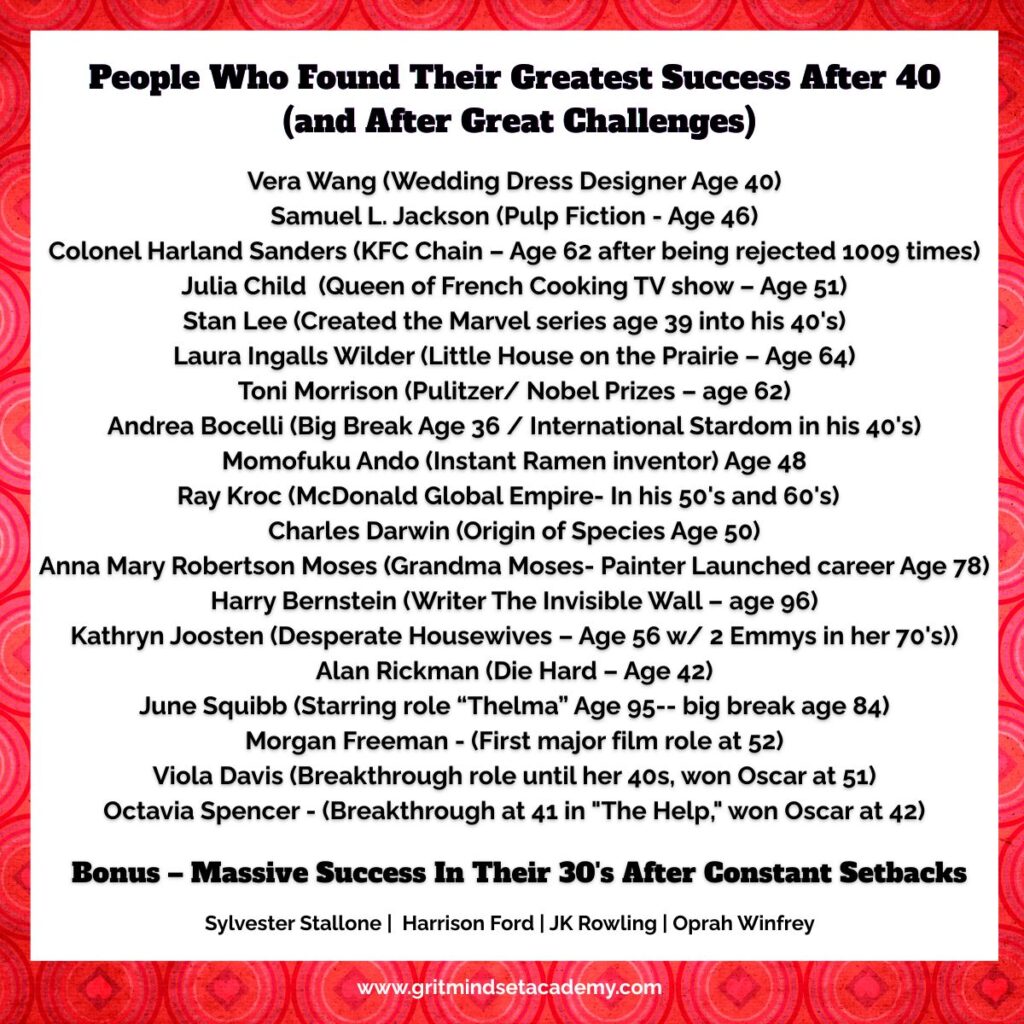
RECOGNIZABLE PEOPLE WHO HAD MAJOR BREAKTHROUGHS AFTER 40 (Following Failure/Crisis/Tragedy)
- Vera Wang – Failed to make the U.S. Olympic figure skating team, worked as a fashion editor until 40, then entered a failing marriage. Started designing wedding dresses at 40, built a billion-dollar empire.
- Samuel L. Jackson – Struggled with crack cocaine addiction through his 30s, went to rehab at 42. His breakout role in Pulp Fiction came at 46, launching his legendary career.
- Martha Stewart – Started her catering business at 35, but her media empire didn’t take off until her 40s. Then faced insider trading conviction at 62, served prison time, and rebuilt her brand even stronger.
- Colonel Harland Sanders (KFC) – Faced multiple business failures, his restaurant was destroyed when interstate construction redirected traffic. Started franchising KFC at 62 after being rejected 1,009 times.
- Julia Child – Didn’t discover cooking until her late 30s while living in France. Her groundbreaking cookbook Mastering the Art of French Cooking was published when she was 49, and her TV show launched at 51.
- Alan Rickman – Worked as a graphic designer and struggled as a theater actor through his 30s. His film career didn’t begin until 42 with Die Hard, followed by worldwide recognition.
- Kathryn Joosten – Hung wallpaper and worked as a psychiatric nurse through her 40s while doing community theater. Didn’t pursue acting professionally until after her husband died when she was 56. Won two Emmys in her 70s for Desperate Housewives.
- Stan Lee – Was ready to quit comics at 40, feeling like a failure. His wife convinced him to write the story he wanted to tell. Created the Fantastic Four at 39, then Spider-Man, X-Men, and the Marvel Universe throughout his 40s.
- Laura Ingalls Wilder – Faced poverty, the death of her infant son, her husband’s paralysis from diphtheria, and their house burning down. Didn’t publish her first Little House book until age 64.
- Toni Morrison – Divorced single mother working as an editor while writing at dawn. Published her first novel at 39, but her masterpiece Beloved came at 56, winning the Pulitzer Prize. Won the Nobel Prize in Literature at 62.
- Harry Bernstein – Wrote for years with no success while caring for his dying wife. After her death at age 93, he wrote The Invisible Wall at 96—it became a bestseller. He published several more books before dying at 101.
- Andrea Bocelli – Lost his sight completely at 12 due to a football accident. Worked as a lawyer through his 30s. His big break came at 36 when Pavarotti heard him, leading to international stardom in his 40s and beyond.
- Momofuku Ando (Instant Ramen inventor) – Lost everything in WWII bombings, faced bankruptcy multiple times. At 48, after his lumber business failed, he invented instant ramen in his backyard shed. Founded Nissin Foods and revolutionized global food culture.
- Anna Mary Robertson Moses (Grandma Moses) – Worked as a housekeeper and farm wife her entire life. Severe arthritis forced her to give up embroidery in her late 70s, so she took up painting at 78. Became internationally famous folk artist, painting over 1,600 works until her death at 101.
- Ray Kroc – Was a struggling milkshake machine salesman, divorced, in poor health, and nearly broke at 52. Discovered a small burger restaurant run by the McDonald brothers. Bought them out and built McDonald’s into a global empire through his 50s and 60s.
- Morgan Freeman – Struggled with small roles for decades, first major film role at 52, became A-list star in his 50s-60s
- Viola Davis – Grew up in extreme poverty, didn’t get breakthrough role until her 40s, won Oscar at 51
- Harrison Ford – Worked as a carpenter until 35, got Han Solo role at 35 after years of struggle
- Octavia Spencer – Worked in casting and small roles for years, breakthrough at 41 in “The Help,” won Oscar at 42
- Ang Lee – Unemployed househusband for 6 years in his 30s, first major film at 38, international success in his 40s
- J.K. Rowling – Though she had her breakthrough with Harry Potter at 32, she faced severe depression, divorce, poverty as a single mother, and contemplated suicide. Her story of overcoming crisis before success is powerful, even though technically just under 40.
- Charles Darwin – Suffered from chronic illness and anxiety throughout his life. Didn’t publish On the Origin of Species until he was 50, after 20+ years of gathering evidence while battling self-doubt and fear of controversy.
BONUS:
Oprah Winfrey is one of the most powerful examples of overcoming adversity and “late” success:
Her story:
- Born into poverty in rural Mississippi to a teenage single mother
- Experienced severe childhood abuse and trauma
- Became pregnant at 14; her son died in infancy
- Was fired from her first TV job as a news anchor at 23 (told she was “unfit for television news” and “too emotionally involved in stories”)
- Didn’t launch “The Oprah Winfrey Show” nationally until age 32 in 1986
- Built her media empire primarily in her 30s, 40s, and 50s
- Became first Black female billionaire at 49
Sylvester Stallone is another one of the BEST examples for this list!
He was 30 years old, broke, sleeping in the Port Authority bus station in NYC, and so desperate he had to sell his dog for $50 because he couldn’t afford to feed him.
He wrote the Rocky screenplay in 3 days after watching a Muhammad Ali fight. Studios wanted to buy it BUT they wanted a big-name star (they offered him up to $360,000 for the script). Stallone refused to sell unless HE could star in it, even though he desperately needed the money.
He held out, they finally gave him a tiny budget ($1 million), and he starred in it at age 30. Rocky was nominated for 10 Academy Awards and won Best Picture in 1977.
And here’s the best part: Once he got paid, the first thing he did was go back and buy his dog back (for $15,000—the guy knew Stallone needed him!).
He’s a perfect example of:
- Facing extreme poverty and rejection
- Believing in himself when no one else did
- Refusing to compromise on his vision even when broke
- Late-ish bloomer (30 isn’t super late, but after years of struggle)
- Persisting through the “poison apple moment”